When I came to work with ACTS I was quite foggy on the details of what ACTS does. I could read the mission statement (included at the top of my blog), but how I wondered exactly how they accomplish this. This entry is intended to answer questions that you may have about ACTS and my work. I am still learning much about this organization, but this is what I've discovered so far!
 A typical view of this countryside. (That's my team walking ahead of me.)
Read the mission statement at the top of the blog. :-)
Focus of ACTS Projects: ACTS works in a "project model" (not an official term), with the focus being to provide clean water to communities that demonstrate need for clean water and where it is practically feasible to build a water system. While building the water system, education/training on health and agriculture is provided in the community.
How big is the project area? When I came, I was picturing working with one small village at a time. In reality, the water system and education/training extends to multiple communities. There are houses scattered all over the hillsides here, not arranged in a clustered "village" as you might expect. The water pipeline winds through the valleys for approx. 6 miles and is proposed to serve 7,730 people from ~40 taps in the system. These same people are the ones we work with on health and agriculture.
Water systems: ACTS is currently using two types of water systems. The main one is a gravity flow system (GFS) which captures high elevation water sources delivers water to a number of communities via a pipeline system. They are also construction rainwater harvest technology (building a tank to catch water running off roofs) for communities above water sources.
Health & Agro-forestry: While the engineers build pipelines, environment and health teams (this is where I'm working) conductive survey of over 100 homes in the project area. We speak with female heads of households, and ask questions on topics such as water availability, their family's general health, illness and mortality, disabilities, HIV/AIDS, nutrition, sanitation, type of fuel used for cooking, availability of fuel, food shortages, farming practices, tree cutting/planting, etc. After the survey we compile data and begin training local volunteers in health and agriculture, who then do trainings and presentations throughout the communities.
Who works for ACTS? There are 20-30 Ugandan staff that do the majority of work for ACTS. They manage the various project areas. There are several full-time Canadian staff that direct the organization and do the necessary administrative work. Each year volunteers and interns come for six-months at a time to help with a new project. There is usually a group of 10-12 Canadians here, but this year there are only 6 of us Westerners. I am a bit of an anomoly in that I'll be around for two years, and that I'm from the U.S. :-)
Community Involvement: ACTS works with the local leaders and community members from the beginning of a project. This partnership is vital. There is a water committee made up of local people that manages decisions about water access (and handles other issues I'm not aware of yet). There are committees set up for each tap to monitor water allocation and maintainance of the pipeline. Local leaders direct us through the community as we take surveys, and act as mediaries to the local population to get them involved and taking ownership of the project. People benefitting from the water are expected to help dig trenches and lay pipe. Local leaders also select volunteers to be trained to teach their community on health and environmental topics.
How long does a project last? ACTS staff work in a community for approximately 10 months while the building and education is taking place. During that time we build a temporary "camp" (see previous post for details) for our living quarters. Afterward, there is some follow up to see that committees are still functioning, that the pipeline is being maintained, and to check with the volunteer educators in the community.
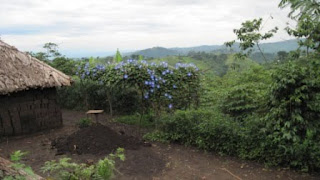 Beautiful morning glories outside a house on one of our walks through the community.
While provided technical services and meeting physical needs, ACTS seeks transformational development in a community - change at the deepest level (spiritually and in attitudes) that will affect all aspects of life. ACTS partners significantly with the Church of Uganda (working with a church group opens many doors here), but because the Candadian government funds a large portion of the projects, overt "evangelism" cannot be a funded part of the project. This, however, does not prevent Christ's name from being proclaimed. Most of the staff are believers, and it is obvious in the way they relate to each other that Christ's love is present. Each night many staff meeting for singing, prayer and Scripture reading. Last year two volunteers (Jefferey & Rosalyn) led a group from a previous project area through a discipleship program. This year the Jeff & Rosalyn have returned to reach another project area and do the second "round" of training with the first group. This group will then be ready to go start more discipleship groups. (Here in Uganda, Christianity has been described as a mile wide and an inch deep.) During this project I have been asked to lead a group of 15 ACTS staff through the discipleship curriculum. They are hungry to learn more, and I am excited about this. I can write more about this later...
I hope this has been helpful to better understand our work here. Please ask questions to prompt answers on areas I have overlooked. There is so much I could say. I am trying to condense it for your sake. :-) Sorry for the number of words in the post and the dearth of photos.
Soon to come... "A Day in my Life" and "People"...


 Children found a place to stand where they could watch the ribbon cutting.
 The Bishop of this diocese came to break the ground, and the community members came out to perform for the ACTS team as a way of thanking and welcoming us.
 These school children are reciting a poem called "Water Is Life" at the Bwesumbu dedication ceremony.
 Of course the celebration included food. There was not question of where our meat came from. Two goats spent the previous night in our compound and were slaughtered on the morning of the celebration. (We watched the process, but I've not shared the more graphic photos.) :-)


